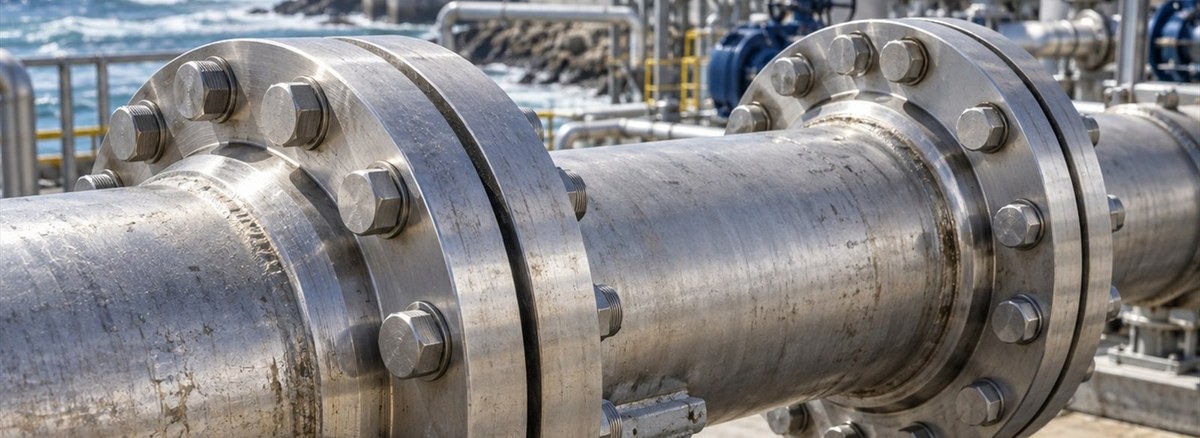
316L is not enough in every environment. When chloride and temperature rise together, austenitic grades become open to stress corrosion cracking. That is where duplex grades come in.
What is duplex?
Duplex stainless steel has a microstructure of roughly equal austenite and ferrite. The result combines two advantages: the corrosion resistance of austenitic grades and the strength of ferritic structure. Yield strength is about twice that of 316L, which means thinner walls and lighter parts at the same pressure.
In flanges the equivalents are ASTM A182 F51 (duplex 2205) and F53/F55 (super duplex).
The PREN value
A rough indicator of pitting resistance, calculated from chromium, molybdenum and nitrogen content. Approximate values for comparison:
| Material | PREN (approx.) | Typical use |
|---|---|---|
| 304L | 18–20 | Low chloride general service |
| 316L | 24–26 | Moderate chloride, process lines |
| Duplex 2205 | 33–35 | Chloride water, geothermal brine, sea water cooling |
| Super duplex | 40+ | High chloride, offshore and sea water systems |
Where it is preferred
- Geothermal reinjection and brine lines
- Sea water cooling circuits
- Chloride bearing process fluids
- Where pressure is high and weight matters; higher strength allows thinner walls
Points to watch
- Phase balance. If the ferrite content falls outside the standard range, both toughness and corrosion resistance drop. Ferrite content may be requested on the certificate.
- Welding procedure. Incorrect heat input upsets the phase balance, so a qualified procedure is required.
- Temperature limit. Duplex grades risk embrittlement above roughly 300 °C and are not suitable for high temperature service.
- Lead time. When duplex flanges are not in stock, production takes considerably longer than carbon steel, so projects need early ordering.
Send your material grade and size list and we will reply with stock and lead time: enquiry form.
FAQ
Is duplex always better than 316L?
Its corrosion resistance and strength are higher, but it is unsuitable above roughly 300 °C and costs noticeably more.
Which certificate should be requested for duplex flanges?
EN 10204 3.1 is the minimum. For critical service, ferrite content and pitting corrosion test reports may also be requested.
Can duplex be used with standard stainless bolting?
Fasteners must match the flange material and the service; an incompatible choice can cause galvanic corrosion.
Send us your material list; we reply with price and lead time the same day.
Request a quote