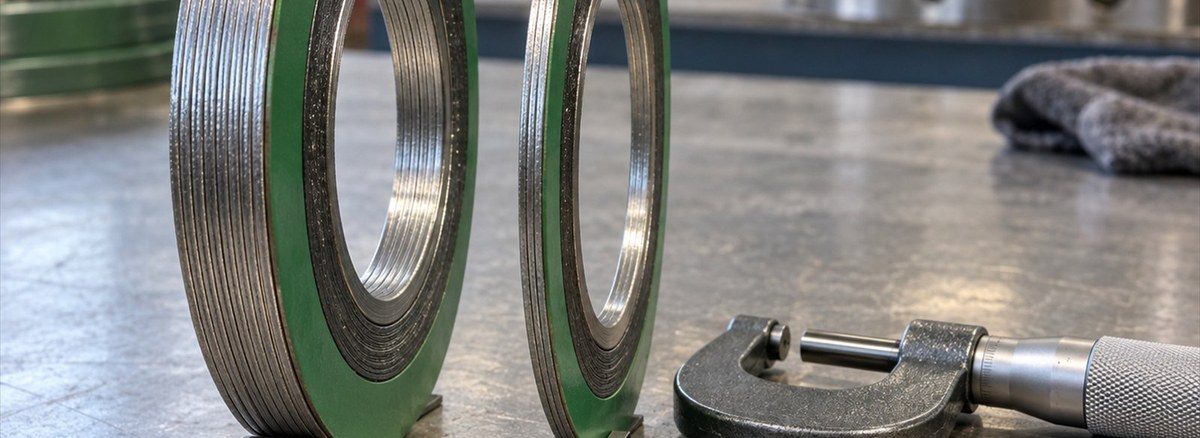
Gasket thickness is not a free choice; it follows flange size, pressure class and the bolt load available.
Standard thicknesses
For gaskets under ASME B16.20 the nominal sealing element thickness is 4.5 mm. After tightening it comes down to about 3.2 mm, which is a practical indicator that the joint was tightened correctly.
The thinner 3.2 mm class is used on small bore, low pressure joints and where bolt load is limited, such as heat exchanger connections. In large diameters, heavier elements of 6.4 and 7.2 mm are preferred to provide enough recovery across a wide face.
| Sealing element | Typical use | After compression |
|---|---|---|
| 2.5 – 3.2 mm | Small bore, low pressure, limited bolt load | ~1.8 – 2.5 mm |
| 4.5 mm (standard) | Most ASME B16.5 and EN flanges | ~3.2 mm |
| 6.4 mm | Large diameter | ~4.7 – 4.9 mm |
| 7.2 mm | Very large diameter and custom work | ~5.3 – 5.6 mm |
Outer ring thickness follows the element; on a standard gasket it is about 3 mm.
Thicker is not always better
A thicker gasket gives more recovery but also demands more bolt load. Where the available load falls short, it never seals fully. It is also stressed laterally under pressure, which is where the inner ring becomes important.
The reverse holds too: a thin gasket needs less load but tolerates flange distortion and misalignment less well.
Thickness and stud length
Changing gasket thickness changes the gap between the flanges, so stud length follows. Using an old stud set with a non standard gasket can leave the nut without full thread engagement.
See how to determine stud bolt dimensions and technical data.
When ordering
If a non standard thickness is required, state it explicitly. Otherwise the part is made to standard thickness and the site receives something different from what it expected.
Send your size and class list: enquiry form.
FAQ
What is the standard gasket thickness?
Under ASME B16.20 the sealing element is 4.5 mm and compresses to about 3.2 mm.
When is a thin gasket used?
On small bore, low pressure joints and equipment flanges where bolt load is limited.
Does thickness affect stud length?
Yes. A change in gasket thickness changes the gap between flanges and therefore the required stud length.
Send us your material list; we reply with price and lead time the same day.
Request a quote