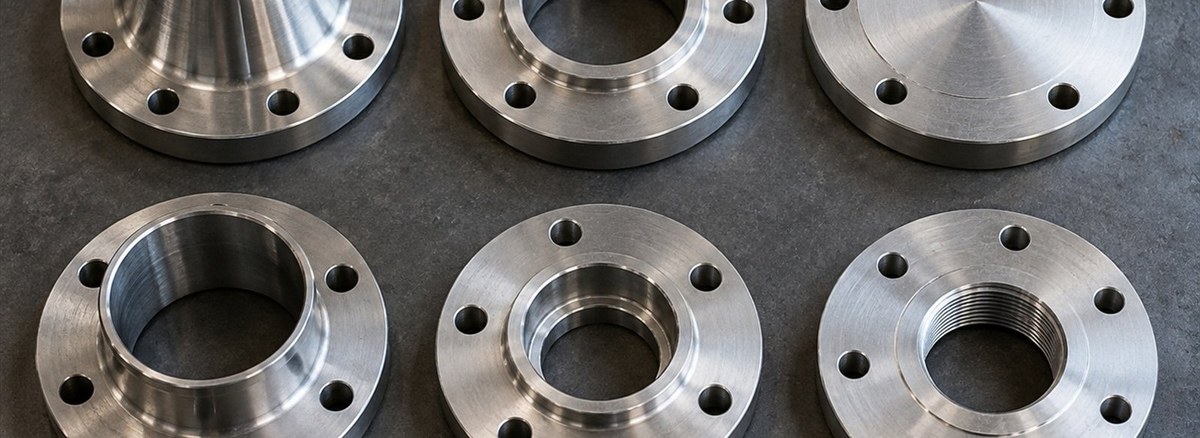
ASME B16.5 defines six main flange types. They all appear to do the same job: joining two parts so they can be taken apart again. What differs is how they carry load and where the weld ends up.
Weld neck (WN)
The tapered hub is joined to the pipe with a butt weld, and stress decreases gradually along the hub. It is the standard choice for high pressure, high temperature, vibration and thermal cycling. The weld is single and fully radiographable. The pipe schedule must be stated when ordering, because the hub bore is machined to the wall thickness.
Slip-on (SO)
The pipe slides into the flange and is held by an inner and an outer fillet weld. Alignment tolerance is generous and fabrication is easier, but the weld root meets stress more abruptly. Common on low pressure water, air and general service lines. See weld neck or slip-on for the full comparison.
Blind
No bore; it closes the line completely. Used for line termination, maintenance isolation and pressure testing, and is thicker than other types of the same size and class. More in what is a blind flange.
Lap joint (LJ)
Two pieces: a stub end welded to the pipe and a loose flange that rotates over it. Bolt holes align easily, so it suits lines that are opened often. On expensive alloy lines the stub end can be alloy while the backing flange is carbon steel, which cuts cost.
Socket weld (SW) and threaded
Both are for small bore lines, generally 2" and below. In socket weld the pipe enters a recess and is fillet welded from outside. The threaded type needs no welding at all, which suits locations where hot work is not permitted. Because threading consumes wall thickness, SCH 80 pipe is normally required.
| Type | Typical size | Connection | Where it stands out |
|---|---|---|---|
| Weld neck | All sizes | Butt weld | High pressure, cycling service |
| Slip-on | Medium and large | Two fillet welds | Low pressure, general service |
| Blind | All sizes | Bolted cover | Line ends, maintenance, testing |
| Lap joint | Medium and large | Stub end + loose flange | Frequent dismantling, alloy saving |
| Socket weld | ≤2" | Recess + fillet weld | Small bore process lines |
| Threaded | ≤2" | Thread | Where welding is not possible |
Three questions that decide the choice
- What are the pressure and temperature? Higher classes push towards weld neck.
- Is the line stressed in operation? Vibration and thermal cycling fatigue fillet welds.
- Will it be opened often? Lap joint shortens assembly time.
Dimensions and stock are on our flange page; send your list through the enquiry form.
FAQ
Which flange type is most common?
Weld neck on process lines and slip-on on utility and low pressure lines are the two most widely used types.
When is a threaded flange chosen?
Where welding is not possible, hot work is not permitted, or on small bore utility lines. Heavy wall pipe is needed because threading reduces the section.
What is the advantage of a lap joint flange?
The loose flange rotates, so bolt holes align easily, and expensive alloy is needed only for the stub end in contact with the fluid.
Send us your material list; we reply with price and lead time the same day.
Request a quote