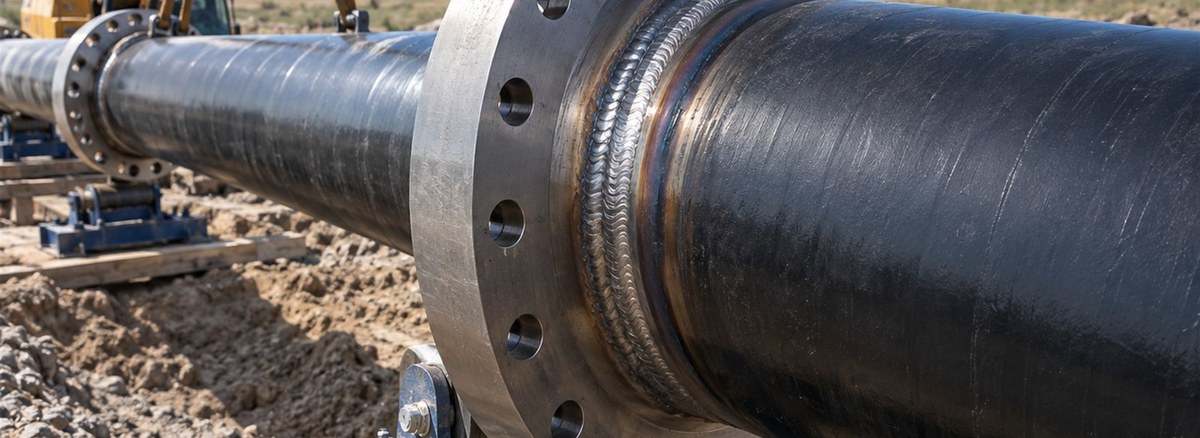
Pipeline projects ask for A694 F52 or F65 rather than A105. The reason is simple: the flange has to match the strength of the pipe it joins.
Why it is needed
Transmission lines use high yield pipe grades such as API 5L X52, X60 and X65, whose yield strength is well above ordinary carbon steel. Using A105 at the flange would make the joint the weak link of the line.
The A694 grades close that gap, and the number gives the minimum yield strength in ksi:
| Grade | Minimum yield (approx.) | Typical match |
|---|---|---|
| F42 | 290 MPa | API 5L X42 |
| F52 | 360 MPa | API 5L X52 |
| F60 | 415 MPa | API 5L X60 |
| F65 | 450 MPa | API 5L X65 |
| F70 | 485 MPa | API 5L X70 |
Strength has consequences
Higher strength comes from chemistry and heat treatment, which has three effects:
- Welding is more sensitive. Preheat and heat input control are needed; poor practice raises hardness.
- Hardness limits matter. NACE MR0175 limits are approached more easily in these grades.
- Heat treatment records are requested. They must appear on the certificate.
Where they are used
Gas and oil transmission lines, station inlets and outlets, pig stations and high pressure gathering lines. In large sizes they are usually produced to MSS SP-44 or ASME B16.47 Series A dimensions.
When ordering
State pipe grade and flange grade together: "to suit API 5L X60 pipe, MSS SP-44, A694 F60". In sour service, request NACE compliance and a hardness report.
See ASME B16.47 and MSS SP-44 and send your list through the enquiry form.
FAQ
What does the 52 in A694 F52 mean?
The minimum yield strength in ksi, roughly 360 MPa.
Can A694 replace A105?
Yes, but not the reverse. An A105 flange on high yield pipe weakens the joint.
What matters when welding?
Preheat and heat input control, because increased hardness is a problem particularly in sour service.
Send us your material list; we reply with price and lead time the same day.
Request a quote