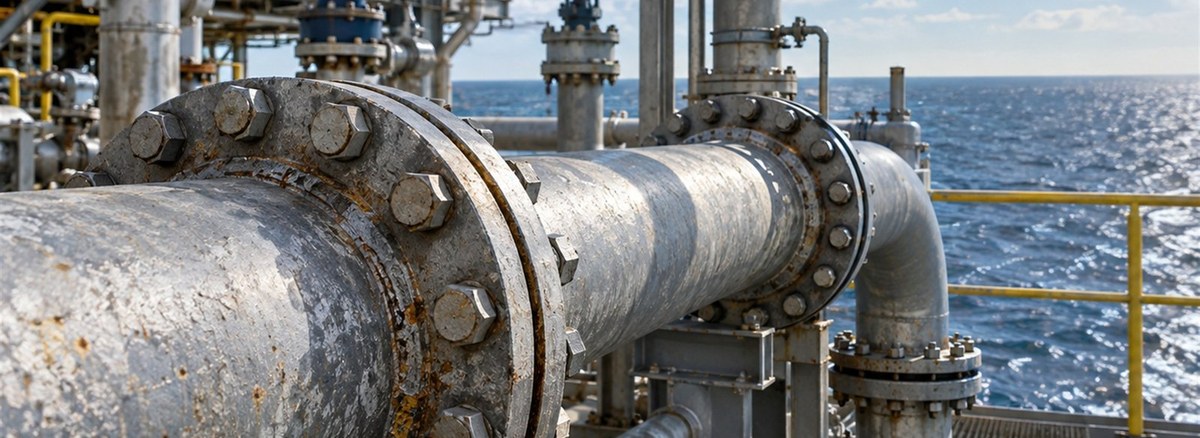
Even carrying the same fluid, a line on an offshore platform is not solved with the same material as one onshore. The difference comes from the environment and the logistics rather than the fluid.
Environment and corrosion
Salt, humidity and wind create constant corrosion pressure offshore. Painted carbon steel that lasts years onshore degrades far faster on a platform. Duplex and super duplex grades, coated fasteners and higher specification paint systems are therefore common offshore.
| Topic | Onshore | Offshore |
|---|---|---|
| Typical flange material | A105, F304L/F316L | F316L, duplex F51, super duplex F53 |
| Fasteners | B7/2H, zinc or xylan coated | PTFE coated or stainless grades |
| Corrosion protection | Paint and insulation detailing | Multi coat paint systems, cathodic protection |
| Weight | Secondary | A primary design constraint |
| Maintenance access | Easy | Limited; lifetime durability expected |
Why weight is critical
Every kilogram on a platform comes out of the load capacity. The high strength of duplex grades turns into an advantage here: thinner walls and lighter parts at the same pressure. Lap joint and compact flange solutions are common for the same reason.
Certification and traceability
Offshore projects widen the document scope: EN 10204 3.2 inspection certificates, PMI, ferrite measurement on duplex, impact testing, dimensional inspection before loading and third party inspection where required. This extends lead time, so planning must start early.
When ordering
State the service environment: open sea, splash zone, buried or enclosed space. The splash zone is the most demanding, and material selection follows accordingly. Where weight is constrained, we give item weights with the quotation.
See duplex stainless flanges and send your list through the enquiry form.
FAQ
Why is duplex preferred offshore?
It resists chloride corrosion and its strength allows thinner, lighter parts.
Why is the splash zone special?
The wetting and drying cycle accelerates corrosion, so material and coating are assessed separately there.
Which documents are requested offshore?
Usually 3.2 inspection certificates, PMI, ferrite measurement on duplex and impact test reports.
Send us your material list; we reply with price and lead time the same day.
Request a quote