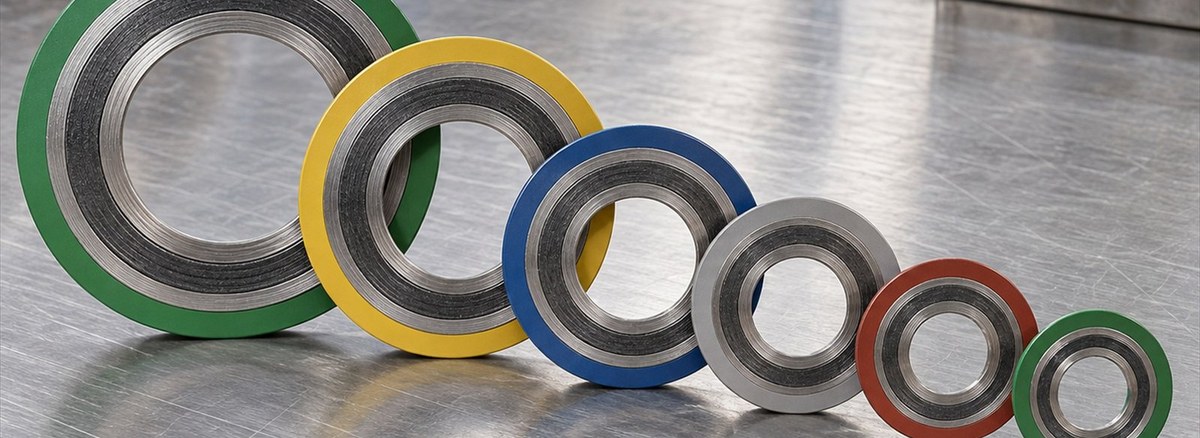
We covered construction and colour codes in a separate article. This one holds the numbers needed at enquiry and installation: configuration, thickness, material limits and seating stress.
Operating range
The spiral wound gasket is designed for service where pressure and temperature fluctuate. The V profiled metal strip provides resilience while the soft filler does the sealing.
- Pressure: up to 250 bar
- Temperature: −200 °C to +550 °C; up to +1100 °C with special materials
- Flange faces: raised face (RF), male-female and tongue-groove joints
- Removal: non adhesive, comes off after service without damaging the flange face
Four configurations
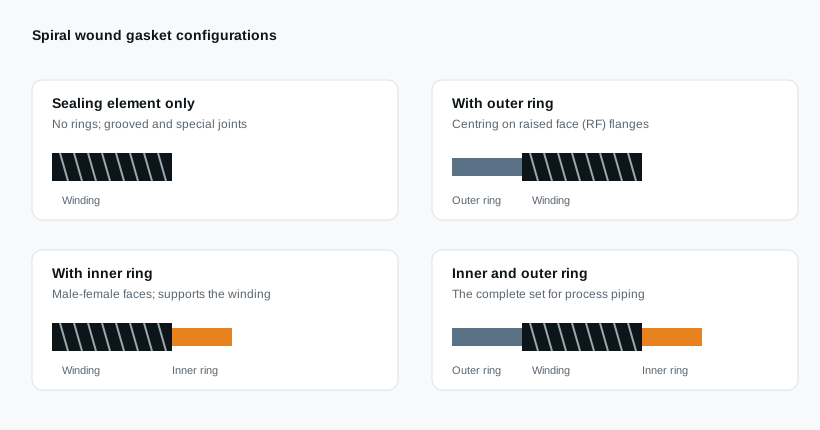
- Sealing element only: No rings. Used in tongue-groove and special joints where the gasket is already retained laterally.
- With outer ring: The outer ring centres the gasket and limits over compression. The standard answer for raised face flanges.
- With inner ring: Used on male-female faces, supporting the winding from inside to prevent buckling.
- With inner and outer ring: The complete set for process piping, standard in higher classes and with PTFE filler.
Standards
| Flange standard | Gasket standard |
|---|---|
| EN 1092-1, EN 1759-1 | EN 1514-2, EN 12560-2 |
| ASME B16.5 (Class 150–2500, ½"–24") | ASME B16.20 |
| ASME B16.47 Series A (MSS SP-44), 26"–60" | ASME B16.20 |
| ASME B16.47 Series B (API 605), 26"–60" | ASME B16.20 |
| GOST 12815 | GOST R 52376, OST 26.260.454 |
| BS 1560 | BS 3381 |
GOST appears on CIS projects, EN in Europe and ASME across the Middle East and the Americas. The gasket follows whichever standard the flange belongs to.
Thickness selection
Sealing element thickness (t1) follows diameter, and outer ring thickness (t2) and the thickness left after fitting follow from it.
| Sealing element t1 (mm) | Tolerance (mm) | Diameter D (mm) | b max (mm) | Outer ring t2 (mm) | Recommended after fitting (mm) |
|---|---|---|---|---|---|
| 7.2 | +0.35 | 100 – 2800 | 33 | 5 | 5.3 – 5.6 |
| 6.4 | +0.3 | 100 – 1600 / 1601 – 3200 | 30 / 25 | 4 | 4.7 – 4.9 |
| 4.8 (standard) | +0.3 | 15 – 630 / 631 – 1600 / 1601 – 2000 | 35 / 30 / 20 | 3 | 3.2 – 3.4 |
| 3.5 | +0.25 | 15 – 1000 | 25 | 2 | 2.3 – 2.5 |
| 3.2 | +0.25 | 15 – 600 | 20 | 2 | 2.3 – 2.5 |
| 2.5 | +0.25 | 15 – 500 | 10 | 1.5 | 1.8 – 2.0 |
The standard thickness is 4.8 mm, used on the great majority of ASME B16.5 and EN flanges. The "after fitting" column is a practical way to confirm the joint was tightened correctly.
Winding materials and temperature limits
| Material | AISI / ASTM | DIN material no. | Temperature range |
|---|---|---|---|
| Carbon steel | – | 1.0038 | −40 / +500 °C |
| Stainless 304 | 304 | 1.4301 | −250 / +550 °C |
| Stainless 304L | 304L | 1.4306 | −250 / +550 °C |
| Stainless 321 | 321 | 1.4541 | −250 / +550 °C |
| Stainless 309 | 309 | 1.4828 | −100 / +1000 °C |
| Stainless 316 | 316 | 1.4401 | −100 / +550 °C |
| Stainless 316Ti | 316Ti | 1.4571 | −100 / +550 °C |
| Stainless 316L | 316L | 1.4404 | −100 / +550 °C |
Filler materials
| Filler | Temperature range | pH | Use | Colour code |
|---|---|---|---|---|
| Graphite | −200 / +550 °C | 0 – 14 | Aggressive media, general process | Grey |
| PTFE | −200 / +250 °C | 0 – 14 | Where chemical resistance is needed | White |
| Ceramic | −200 / +1100 °C | – | Very high temperature | Light green |
| Mica | −200 / +1000 °C | – | High temperature | Pink |
Seating stress (Q)
A gasket only seals under sufficient surface stress. The values below are in N/mm² at +20 °C. "Single-side enclosed" means a gasket with an outer ring only, "double-side enclosed" one with inner and outer rings.
| Filler | Single-side enclosed (min / recommended / max) | Double-side enclosed (min / recommended / max) |
|---|---|---|
| Graphite | 50 / 90 / 180 | 50 / 122 / 300 |
| PTFE | 50 / 80 / 130 | 50 / 110 / 250 |
| Ceramic | 60 / 90 / 150 | 70 / 120 / 300 |
This table is the starting point for bolt torque: the required surface stress multiplied by the gasket area gives the total bolt load. See flange bolt torque for the calculation.
Flange surface finish
The recommended finish for spiral wound gaskets is Ra 3.2 – 12.5 µm. A smoother face gives the gasket nothing to grip; a rougher one leaves leak paths. More in flange face finish and Ra.
Non standard shapes
Shapes other than round are available: oval and elliptical gaskets, and bar types for heat exchanger covers. These are produced from drawings, so a sectional and dimensional drawing is needed for a quotation.
Send your list with sizes, pressure class, winding and filler material: enquiry form. See our gasket page for the product group.
FAQ
What is the standard gasket thickness?
4.8 mm is the common choice; 6.4 and 7.2 mm are used in large diameters and 3.2 and 2.5 mm in small ones.
What temperature does each filler withstand?
Graphite to +550 °C, PTFE to +250 °C, mica to +1000 °C and ceramic to +1100 °C.
Why does seating stress matter?
A gasket seals only under adequate surface stress; that value multiplied by the gasket area gives the bolt load and torque.
Which type suits male-female flanges?
No outer ring is needed; the inner ring type is used because the gasket is already retained laterally in the recess.
Send us your material list; we reply with price and lead time the same day.
Request a quote