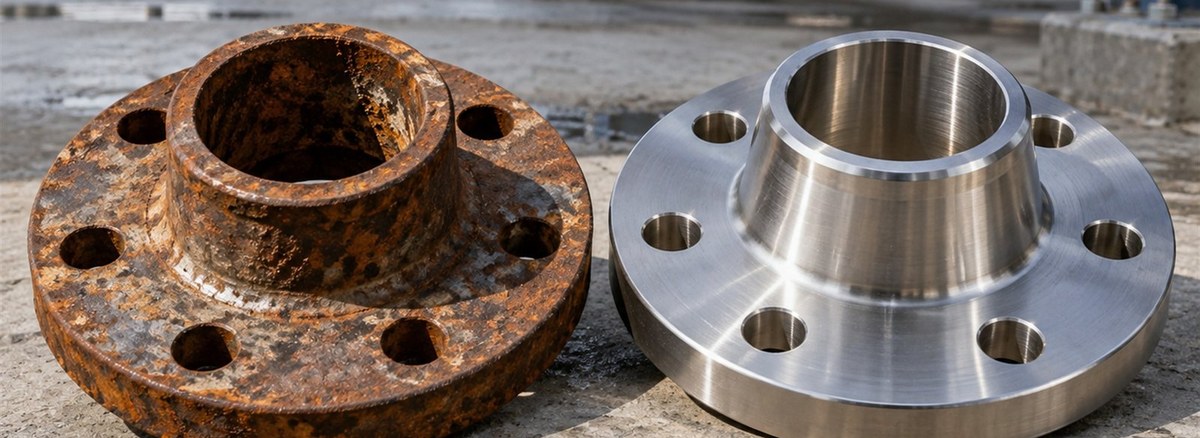
On most projects this decision is made on first cost. Yet the difference between carbon steel and stainless has far more to do with service life and maintenance than with the purchase price.
First cost and life
A stainless flange costs several times a carbon steel one of the same size. In corrosive service, however, carbon steel needs regular painting, coating, thickness monitoring and periodic replacement. Over a ten year window the gap narrows, and in some services it reverses.
| Criterion | Carbon steel | Stainless |
|---|---|---|
| First cost | Low | High |
| Corrosion resistance | Depends on coating and allowance | High, depending on environment |
| Maintenance | Paint, thickness checks | Low |
| Temperature | A105 up to about 400 °C | Wide range in austenitic grades |
| Strength | High with A694 grades | Lower, except duplex |
| Availability | Widely stocked | Common grades stocked |
Where carbon steel is right
- Non corrosive water, steam, air and hydrocarbon lines
- Lines where a corrosion allowance and thickness monitoring are practical
- High pressure transmission lines (A694 grades)
- Budget sensitive, easily accessible lines
Where stainless is right
- Chloride bearing, acidic and chemical service
- Food, pharmaceutical and high purity water lines
- Hard to reach, expensive to maintain locations (buried, elevated, offshore)
- Processes where contamination is unacceptable
Middle paths
A line does not have to be all stainless. Common compromises: stainless only where it contacts the fluid, coated carbon steel, a lap joint with a stainless stub end and carbon steel backing flange, or upgraded material only on the critical section.
Share your service conditions and we will price alternatives item by item: enquiry form. See also A105 or A182.
FAQ
Does stainless always last longer?
It depends on the environment. In hot chloride service even 316L may fall short, and duplex is then considered.
How much corrosion allowance is left on carbon steel?
Typically 1.5 to 3 mm depending on service, monitored by thickness measurement.
Is mixing materials a problem?
In humid environments dissimilar metals can corrode galvanically, so fastener and gasket selection must account for it.
Send us your material list; we reply with price and lead time the same day.
Request a quote