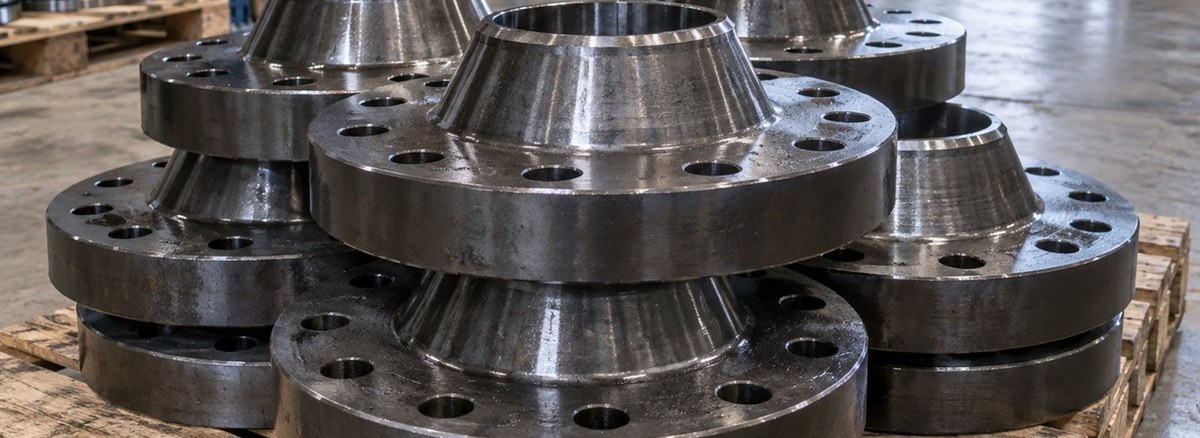
ASTM A105 is the first material that comes to mind for a carbon steel flange. It is the most widely used forged grade on process lines, but it is not suitable for every service. Knowing its limits prevents a wrong order.
What is A105?
A105 is a material standard for carbon steel forged parts used in pressure systems: flanges, fittings and valve bodies. It is supplied normalised or as forged, with chemistry and mechanical properties defined in the standard. Typical values are around 250 MPa yield and 485 MPa tensile strength.
Where it is used
- General process lines carrying water, steam, air and hydrocarbons
- Service from ambient up to roughly 400 °C
- The great majority of ASME B16.5 and B16.47 flanges
- Non corrosive service, or lines with a corrosion allowance
Its limits
| Condition | Issue | Alternative |
|---|---|---|
| Low temperature (below −29 °C) | Risk of brittle fracture | ASTM A350 LF2 (impact tested) |
| Continuous service above 425 °C | Strength loss, graphitisation | A182 F11, F22, F91 |
| Chloride or acidic fluid | Corrosion | A182 F304L, F316L, duplex |
| Sour service (H₂S) | Hardness limits | NACE MR0175 compliant A105 |
The key difference between A105 and A350 LF2 is that LF2 has passed low temperature Charpy impact testing. LF2 is specified for outdoor lines in cold climates and for LNG and refrigeration service.
Heat treatment
The standard requires heat treatment above certain sizes and thicknesses. Where post weld heat treatment is needed, it must be recorded on the certificate. On heavy wall, high pressure joints this record is requested during inspection.
Pre-order checklist
- Standard and class: ASME B16.5 150#/300#/600#, face type RF or RTJ
- Material: A105, or A350 LF2 for low temperature
- Certificate: EN 10204 3.1, or 3.2 where required
- NACE MR0175 compliance and hardness report for sour service
- Pipe schedule if a weld neck flange is ordered
- Surface preparation grade if coating or painting is requested
Stock and dimensions are on our flange page.
FAQ
Up to what temperature can A105 be used?
In practice it is widely used to about 400 °C. Above that, chromium molybdenum alloy grades are preferred for continuous service.
What is the difference between A105 and A350 LF2?
LF2 is impact tested at low temperature, which reduces the risk of brittle fracture in cold service.
Does an A105 flange rust?
Being carbon steel, it is open to corrosion. Coating, corrosion allowance or stainless grades are considered for corrosive service.
Send us your material list; we reply with price and lead time the same day.
Request a quote