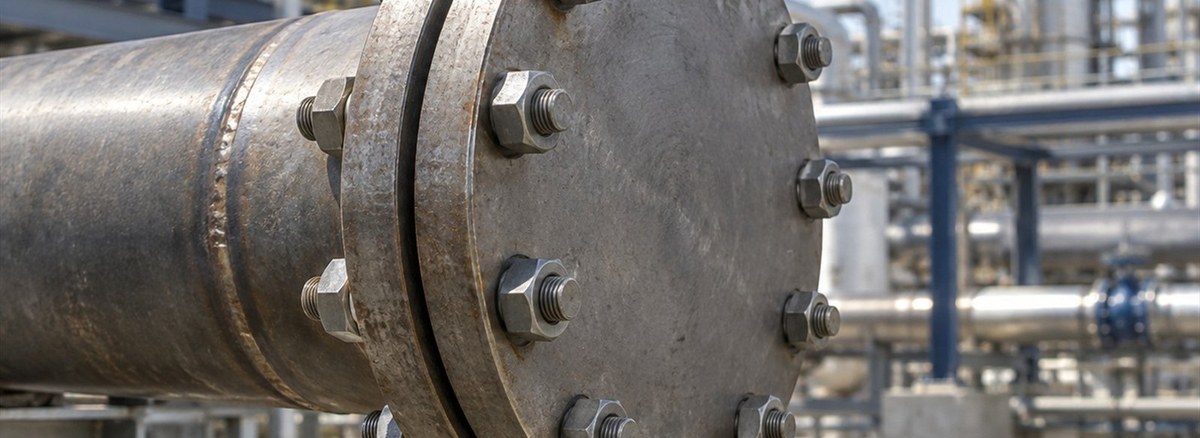
The safest way to close a pipeline is not to weld a cap on it, but to leave a removable cover. That is exactly what a blind flange does: it holds the line under pressure yet can be opened again in a couple of hours.
What is a blind flange?
A blind flange is a solid flange with no bore. It is bolted to its mating flange with a gasket and studs, closing the line completely. The most common standards are ASME B16.5 (2½"–24") and EN 1092-1. ASTM A105 leads in carbon steel, A182 F304/F316 in stainless.
The missing bore is not the only difference. Because pressure acts on the whole face, a blind flange is thicker than a weld neck flange of the same size, so comparing weight and price size by size is misleading.
Where is it used?
- Line termination. The end of a line that will be extended later is closed with a blind flange rather than a welded cap.
- Maintenance isolation. Inlet and outlet of equipment taken out of service are blinded.
- Pressure testing. The section under test is closed off and reopened afterwards.
- Spare outlets. Tee branches left for future use are capped.
- Equipment covers. Pump, tank and filter connections are closed with blinds.
A blind flange is a cover, not a lock. It does not replace an isolation procedure: the line must be drained and depressurised first.
Pressure class and material
The pressure a blind flange can hold changes with class and temperature. A 150# A105 flange handles roughly 19 bar at ambient, and markedly less at 400 °C. Three pieces of information must therefore always come together:
| Information | Why it matters |
|---|---|
| Size and standard | ASME B16.5 and EN 1092-1 differ in bolt circle and bolt count |
| Pressure class | 150#, 300#, 600#, 900# sets the body thickness |
| Design temperature | Allowable pressure drops as temperature rises |
| Material grade | A105, A350 LF2 (low temperature), A182 F316 (corrosion) |
| Face type | RF, FF or RTJ; must match the mating flange |
Common installation mistakes
- Choosing the gasket without regard to service. Graphite filled spiral wound gaskets are far more stable at high temperature than PTFE.
- Not recalculating stud length. A blind flange is thicker, so the stud length differs from a normal flange pair.
- Tightening in one pass. Without a star pattern and staged torque the gasket is crushed unevenly and leaks.
- Closing a dirty face. Old gasket residue and scratches ruin the seal.
- Mating RF to FF. Different face types change the gasket seating area.
What to write on the enquiry
"8 inch blind flange" is not enough. Give the standard, pressure class, material grade, face type and certificate level and both price and lead time come out right the first time: *ASME B16.5, 8", 300#, RF, ASTM A105, EN 10204 3.1 — 6 pcs.*
See our flange page for stock and dimensions, or send your list through the enquiry form.
FAQ
What is the difference between a blind flange and a cap?
A blind flange is bolted and removable, while a cap is welded to the pipe end. Where the line must be reopened, the blind flange is used.
Why is a blind flange thicker?
With no bore, pressure acts across the entire face and bending stress increases, so the standard specifies a thicker body for the same size and class.
Which standard should I order?
The same one as the mating flange. ASME B16.5 and EN 1092-1 differ in bolt circle and bolt count, which makes mixed assembly impossible.
Send us your material list; we reply with price and lead time the same day.
Request a quote