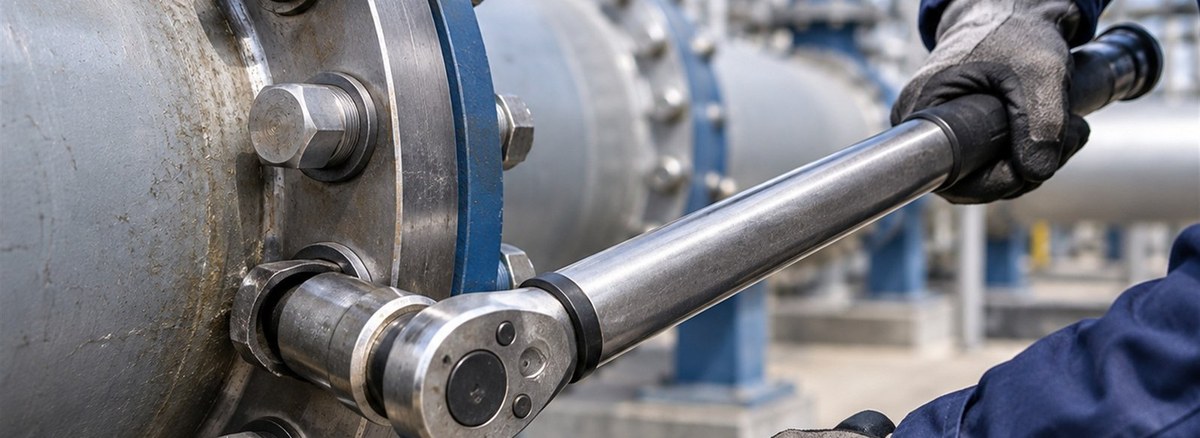
Even with the right flange, the right gasket and the right bolts, a joint leaks if the torque is wrong. Torque delivers the force that compresses the gasket enough to seal without destroying it.
Torque is not read from one table
Treat any generic "flange torque table" with care, because the required value depends on all of the following:
| Variable | Effect |
|---|---|
| Gasket type | A spiral wound gasket needs far higher surface stress than a soft gasket |
| Pressure class | Higher classes mean larger bolts and greater preload |
| Bolt size and grade | B7 and B8M carry different preload at the same diameter |
| Friction coefficient | Lubricated and dry threads can differ by more than 30% in torque |
| Flange face | RF, FF and RTJ have different gasket seating areas |
If the project specification gives a value, use it. If not, calculate from the gasket manufacturer's required surface stress and the bolt count.
Staged tightening
Whatever the torque, the sequence is the same:
1. Hand tighten to bring the flanges parallel 2. Apply about 30% of target torque in a star pattern 3. Move to 60% in the same sequence 4. Reach 100% in the same sequence 5. Finish with one clockwise sequential pass to catch any loose bolt
Applying full torque in one go crushes the gasket unevenly. Most field leaks we see come from skipping this step.
Lubrication and friction
Most of what the torque wrench reads is spent overcoming friction. Anti seize on the threads and the nut bearing face means higher preload at the same torque, so the friction condition assumed in the calculation must match what happens in the field. Never apply grease or oil to the gasket face.
Re-check after the first heat up
On lines that heat and cool, the gasket beds in and bolt load drops. A torque check after the first run prevents most later leaks and should be part of the installation plan on hot lines.
Tensioning instead of torque
On large diameter, high class joints, hydraulic bolt tensioning is preferred. It removes the friction uncertainty of torque and preloads all studs simultaneously and equally. It is standard practice on critical flanges during refinery and power plant turnarounds.
Let us quote flange, gasket and stud sets on one list: enquiry form. For installation steps see five rules for fitting a flange.
FAQ
Can flange torque be taken from a standard table?
Generic tables are only a starting point. The correct value follows gasket type, bolt grade, diameter and friction condition.
Should threads be lubricated?
Anti seize makes preload predictable by lowering friction, but the assumed friction coefficient in the calculation must be known.
When should torque be re-checked?
Always after the first heat up on thermally cycled lines, then periodically according to the maintenance programme.
Send us your material list; we reply with price and lead time the same day.
Request a quote