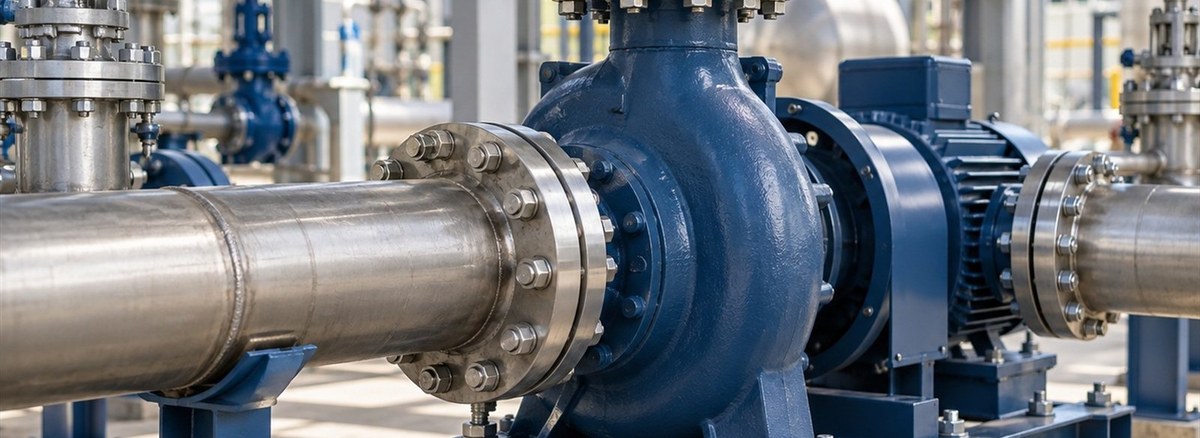
The tightest way to join a line is to weld it. Even so, plants contain thousands of flanged joints, for a simple reason: a welded line cannot be taken apart, a flanged one can.
Where a flanged joint is needed
- Equipment connections. Pumps, valves, filters, heat exchangers and vessels must be removable for maintenance.
- Line ends. Lines to be extended later are closed with a blind flange.
- Test and cleaning points. Pressure testing, pigging and chemical cleaning need access.
- Material transitions. Moving from stainless to carbon steel is done with a flange and a suitable gasket rather than a weld.
- Cathodic protection. Where electrical separation is required, an isolation gasket set is used, which is only possible in a flanged joint.
- Temporary lines. Construction and commissioning lines are dismantled and moved.
Where welding wins
| Criterion | Flanged | Welded |
|---|---|---|
| Dismantling | Within hours | Cutting and rewelding needed |
| Leak risk | Depends on gasket and torque | Very low |
| Initial cost | Flange, gasket and stud cost | Lower material cost |
| Maintenance cost | Low | Every intervention costs labour |
| Space | Clearance needed for bolting | Compact |
| Insulation and paint | Needs detailing | Continuous |
On critical, buried or hard to reach lines the number of flanges is deliberately reduced. Every flange is a potential leak point.
Design considerations
- Do not add flanges that are not needed; welding is safer where dismantling is not required.
- Leave clearance for a torque wrench to turn.
- Select the flange class for the worst condition on the line, not the average.
- Both flanges must share the same face type and standard; see flange face types.
- The gasket must suit the service: how to select a flange gasket.
Dimensions and stock are on our flange page; send your list through the enquiry form.
FAQ
Should every equipment connection be flanged?
Flanges are preferred wherever equipment must be removed for maintenance. On line sections that will not be dismantled, welding is cheaper and safer.
Does reducing flange count reduce leaks?
Yes. Every flange means a gasket and a bolted joint, so unnecessary flanges raise the probability of a leak.
What is used instead of flanges on small bore lines?
Socket weld or threaded fittings are common at 2" and below; unions are used where dismantling is required.
Send us your material list; we reply with price and lead time the same day.
Request a quote