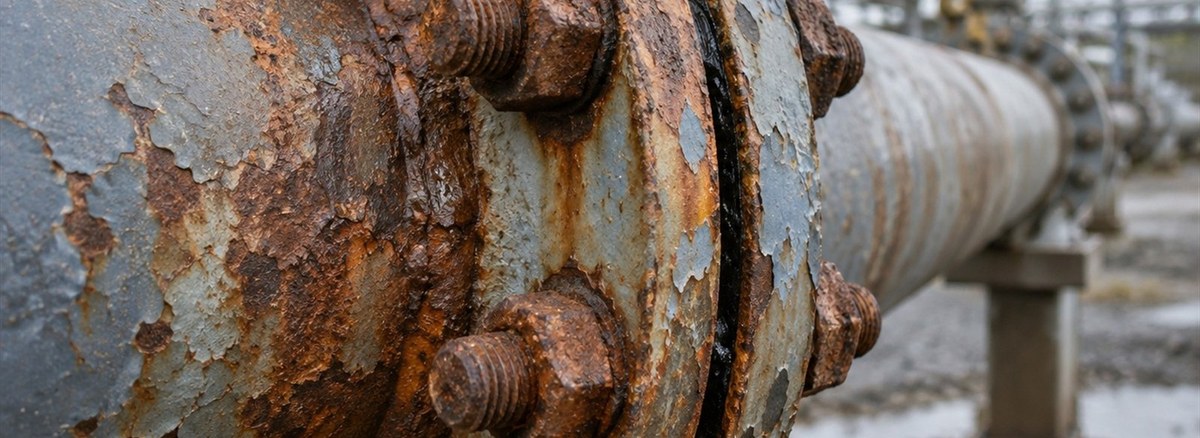
In a planned outage the biggest time loss is often not the flange itself but bolts that will not come off. Corrosion damages the sealing face and multiplies maintenance time.
Where corrosion starts
- The flange face. Moisture is trapped in the narrow gap between gasket and face, and crevice corrosion begins.
- Bolts and nuts. They are the most exposed and thinnest sections, so they go first.
- Dissimilar metal contact. A stainless flange with carbon steel studs forms a galvanic couple in a humid environment.
- Under insulation. Wet insulation causes corrosion under insulation (CUI); the 60–175 °C range is the most critical.
- On buried lines. Corrosion accelerates wherever cathodic protection drains away.
Measures that work
| Measure | What it does |
|---|---|
| Coated fasteners | Extends bolt and nut life |
| Correct material matching | Removes the galvanic couple |
| Flange guard (spray shield) | Limits spray on leakage and moisture ingress |
| Isolation gasket set | Provides electrical separation on protected lines |
| Surface preparation and paint | The basic defence against external corrosion |
| Insulation detailing | Keeps water out from under the insulation |
During installation
- Clean residue and rust from the face without scratching it
- Apply anti seize to the bolt threads only, never on the gasket
- Torque in a star pattern and in stages; uneven bolt load opens gaps
- Re check torque after the first heat up on thermally cycled lines
- Paint the outside surfaces, not the gasket face
- Replace the gasket, and studs where needed, every time a joint is opened
Corrosion in storage
Material delivered early often waits outdoors. Flange faces should be protected with covers or a film of oil, and stainless items should not share a rack with carbon steel. Carbon steel dust on a stainless surface starts surface rusting.
Share your list and we will agree the right coating class and material combination: enquiry form.
FAQ
Why do flange bolts corrode first?
They are the thinnest exposed sections and their coating is often damaged during installation, so corrosion shows there first.
Can anti seize be applied to the gasket face?
No. It goes on the bolt threads only; any on the gasket face harms sealing.
How is corrosion under insulation spotted?
Wet or stained insulation, blistered paint and rust streaks are the signs. The insulation is opened at suspect points for inspection.
Send us your material list; we reply with price and lead time the same day.
Request a quote