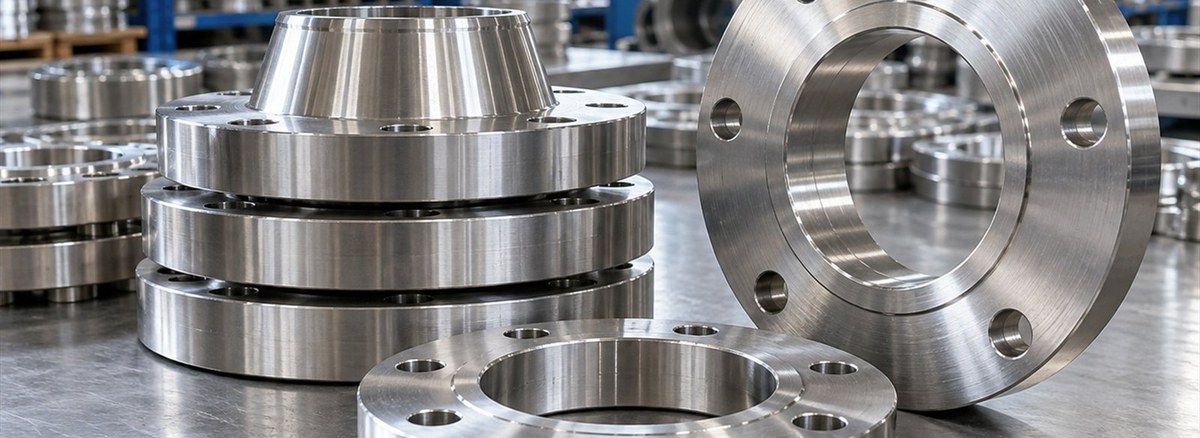
The sentence we hear most often when a stainless flange is requested is "304 will do, it is stainless anyway". But stainless steel does not resist corrosion absolutely; it resists it in a given environment. A wrong grade shows up not in the first year, but in the third.
The difference between 304 and 316
Both are austenitic stainless steels. The key difference is the 2–3% molybdenum in 316, which markedly improves resistance to pitting and crevice corrosion in chloride bearing environments.
| Environment | 304 | 316 |
|---|---|---|
| Municipal water, low chloride | Suitable | Unnecessary cost |
| Sea water, saline environment | Not suitable | Limited; duplex is safer |
| Chloride bearing process fluid | Not suitable | Suitable |
| Food and pharmaceutical lines | Suitable in most cases | Preferred where aggressive cleaning agents are used |
| Geothermal brine | Not suitable | Assessed against chloride level |
Where chloride and temperature are both high, as in geothermal service, even 316 is open to stress corrosion cracking and duplex grades come into the discussion.
What the L grade means
304L and 316L have reduced carbon content, which limits chromium carbide precipitation at grain boundaries during welding and preserves corrosion resistance in the weld zone. For welded fabrication the L grade is preferred; in flanges the equivalents are ASTM A182 F304L and F316L.
"Stainless" alone on a certificate is not enough. The grade, heat number and chemical analysis must appear on the document.
Forged or cast
Flanges are normally forged products under ASTM A182. Cast bodies are more common in valves (A351 CF8, CF8M). Cast stainless flanges are sometimes offered as an alternative; specifications for pressure service generally require forged material, so the production route must be confirmed on the certificate.
Galvanic corrosion: stainless flange, carbon steel stud
Bolting a stainless flange with carbon steel studs is common in the field. In a humid environment the pair forms a galvanic couple and the studs corrode quickly. The fix is either a suitable fastener grade or an appropriate coating.
If the line is cathodically protected, an isolation gasket set is needed for electrical separation.
Pre-order checklist
- Grade: F304, F304L, F316, F316L
- Standard and class: ASME B16.5 150#/300# or EN 1092-1 PN16/PN40
- Face type: RF, FF or RTJ
- Certificate: EN 10204 3.1, or 3.2 where required
- PMI report and heat number traceability if requested
- Compatibility of gasket and fastener material with the flange
Stock and dimensions are on our flange page; send your list through the enquiry form.
FAQ
Is 316 always better than 304?
Its corrosion resistance is higher, but it is not needed everywhere. In chloride free service 304 performs well and costs less.
When is the L grade required?
In welded fabrication and where post weld heat treatment is not possible. It preserves corrosion resistance in the weld zone.
Which studs should be used with stainless flanges?
In humid or corrosive environments carbon steel studs may corrode galvanically; a suitable stainless grade or coated fastener should be selected.
Send us your material list; we reply with price and lead time the same day.
Request a quote