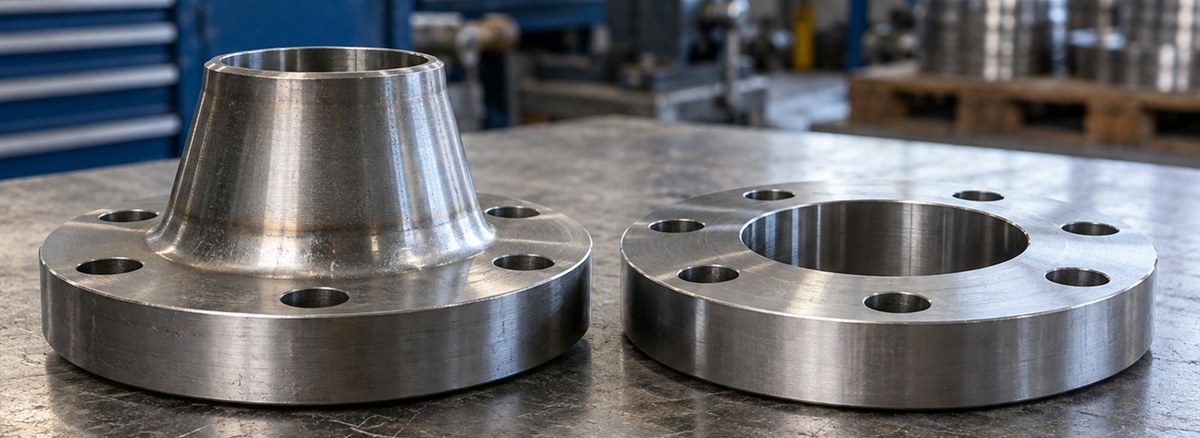
When two flange types of the same size and class are compared, the decision is usually made on price. Yet the difference between weld neck and slip-on has far more to do with the life of the line than with installation cost.
The basic difference
A weld neck flange (WN) has a tapered hub, and the pipe is joined to the end of that hub with a single butt weld, away from the flange body. In a slip-on flange (SO) the pipe slides inside the flange and is held by two fillet welds, one inside and one outside.
This structural difference has three consequences: stress distribution, inspectability and alignment tolerance.
| Criterion | Weld neck (WN) | Slip-on (SO) |
|---|---|---|
| Weld type | Single butt weld | Inner and outer fillet weld |
| Stress transition | Smooth, through the hub | Concentrated at the weld root |
| Radiography | Fully possible | Limited on fillet welds |
| Alignment | Needs more accuracy | More forgiving |
| High temperature and cycling | Suitable | Limited |
| Flange cost | Higher | Lower |
When to use weld neck
- High design pressure, especially class 300# and above
- Lines that heat up and cool down; thermal cycling fatigues fillet welds
- Where vibration exists, such as pump and compressor discharges
- Where radiographic inspection is specified
- Hazardous service: flammable, toxic or H₂S containing fluids
When slip-on is enough
- Low pressure water, air and general service lines
- Class 150# lines operating close to ambient temperature
- Where wide alignment tolerance is needed in the field
- Temporary lines and utility connections
This is a starting point, not a rule. If a piping class list exists, it already defines the type to be used.
Comparing cost properly
The purchase price of a slip-on flange is lower, but comparing flange prices alone is misleading. Two fillet welds take more labour and consumables than one butt weld, and the butt weld requires the pipe end to be bevelled. In small sizes slip-on usually stays cheaper overall; in large diameters and heavy walls the gap closes.
Pre-order checklist
- Standard: ASME B16.5 or EN 1092-1
- Pressure class and face type: 150# RF, 300# RTJ and so on
- Material: A105, A350 LF2, A182 F316
- For weld neck, the pipe schedule; the hub bore must match the pipe
- Certificate level: EN 10204 3.1 or 3.2
The most frequent mistake with weld neck flanges is ordering without stating the schedule. The hub bore is machined to the pipe wall thickness, so a SCH 80 hub on SCH 40 pipe leaves a wall mismatch at the weld.
Dimensions and stock are on our flange page; send your list through the enquiry form.
FAQ
Can slip-on flanges be used at high pressure?
Standards may allow it, but fillet welds fatigue faster under pressure and cycling. Weld neck is preferred above class 300# and on thermally cycled lines.
Why is the pipe schedule asked for on weld neck orders?
The hub bore is machined to the pipe wall thickness. Without the schedule a wall mismatch occurs at the weld and acceptance criteria cannot be met.
Is the inner weld mandatory on slip-on flanges?
Yes. With only the outer fillet weld the root area stays exposed to corrosion and cracking; standard practice is to weld both inside and outside.
Send us your material list; we reply with price and lead time the same day.
Request a quote