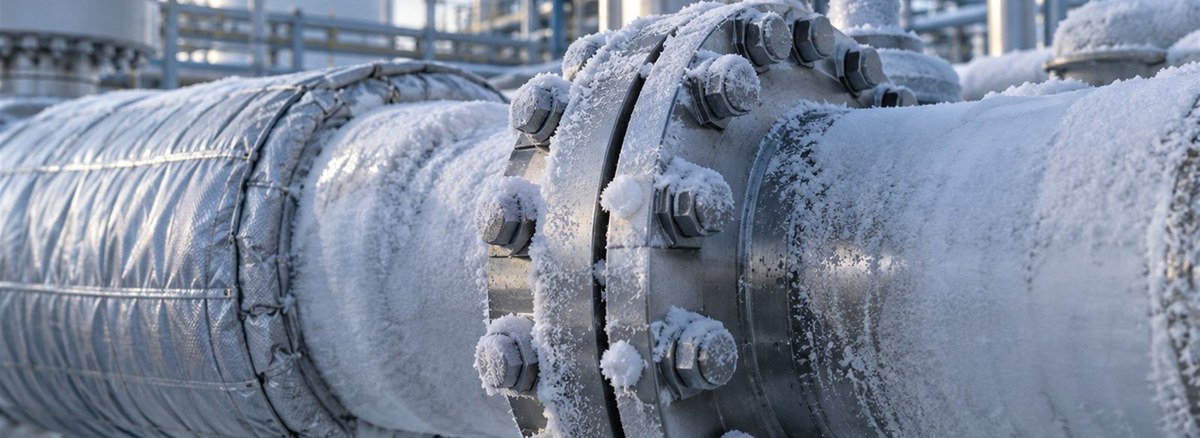
At room temperature carbon steel behaves in a ductile way: it stretches before it breaks. As temperature falls that behaviour changes, and below a certain point the material breaks like glass, without warning. That is brittle fracture.
Why it happens
Steel has a ductile to brittle transition temperature. Below it, a crack propagates without absorbing energy. Three conditions together are enough: low temperature, tensile stress and a crack starter such as a notch, weld defect or sharp corner.
The best known historical examples are welded ships whose hulls split in cold water. The same mechanism applies to piping today.
What the impact test proves
A Charpy impact test measures the energy needed to break a notched specimen at a defined temperature. When the certificate shows the test temperature and energy values, ductile behaviour at that temperature is documented. "Suitable for low temperature" without a test temperature means nothing.
A105 versus A350 LF2
| Criterion | A105 | A350 LF2 |
|---|---|---|
| Impact testing | Not mandatory in the standard | Tested at −46 °C (Class 1) |
| Typical use | Ambient and above | Cold climate, LNG, refrigeration |
| Chemistry control | General | Tighter, with grain size control |
If the temperature falls below −29 °C, or the specification calls for impact testing, A350 LF2 is required. Austenitic stainless grades (304L, 316L) keep their ductility at low temperature and are preferred in cryogenic service.
In design and installation
- Avoid sharp corners and notches; cracks start there
- Document post weld heat treatment where required
- Pressure test at ambient temperature; testing with cold water raises the risk
- Use low stress stamps for marking
See our cryogenic valves page and send your material list through the enquiry form.
FAQ
Below which temperature is impact testing required?
In practice −29 °C is taken as the threshold, below which impact tested grades are specified.
Can A105 be used in cold service?
It is not recommended, because the standard does not require impact testing; A350 LF2 is used instead.
Is stainless always suitable for cold service?
Austenitic grades keep ductility at low temperature, but pressure class and corrosion conditions are assessed separately.
Send us your material list; we reply with price and lead time the same day.
Request a quote