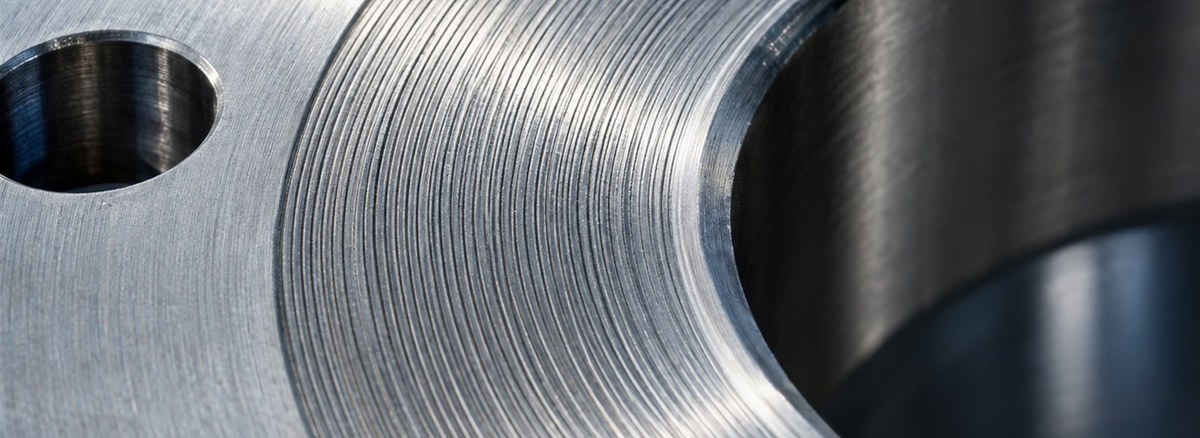
Face type and surface finish are two different specifications. One describes the form (RF, FF, RTJ), the other the machining pattern on that form. The gasket seals by keying into that pattern.
Finish patterns
- Spiral serrated: A continuous spiral groove cut with a single point tool from the centre outwards. This is the standard description in ASME B16.5 and the most common supply.
- Concentric serrated: Separate circular grooves sharing the same centre. Some specifications require it because it removes the leak path a continuous spiral can create.
- Smooth finish: No visible tool marks. Used with soft and faced gaskets, particularly PTFE envelope types.
Ra range by gasket type
| Gasket | Typical Ra range | Note |
|---|---|---|
| Spiral wound | 3.2 – 6.3 µm | The most common band; standard flange supply usually sits here |
| Kammprofile | 3.2 – 6.3 µm | The graphite layer beds into the grooves |
| Soft sheet gasket | 3.2 – 12.5 µm | Tolerates a rougher surface |
| PTFE faced gasket | 1.6 – 3.2 µm | Needs a smoother face |
| Metal ring (RTJ) | 1.6 µm and below | Groove surface; no serration wanted |
Too smooth and the gasket has nothing to grip, so it creeps under temperature. Too rough and the groove roots leave leak paths.
How to check it in receiving
The practical method is a comparison block: the face is compared against standard roughness samples. For a closer check, a portable roughness gauge is used. Inspection also looks for radial scratches, impact marks and burrs, and whether the protective cover stayed in place during transport.
A radial scratch is a leak path regardless of groove depth, and no gasket will close it.
When ordering
If the specification calls for a particular finish pattern or Ra range, state it on the enquiry; otherwise the part is produced with the standard spiral serration. If a faced gasket will be used, request the smoother finish at the order stage.
See flange face types and how to select a flange gasket, and send your list through the enquiry form.
FAQ
What is the Ra value?
The arithmetic average roughness of the surface in micrometres, which governs how the gasket keys into the face.
What happens if the face is too smooth?
The gasket finds nothing to grip and the risk of creep and leakage rises under pressure and temperature.
Is a radial scratch acceptable?
No. It creates a direct leak path under the gasket, and the face must be remachined.
Send us your material list; we reply with price and lead time the same day.
Request a quote