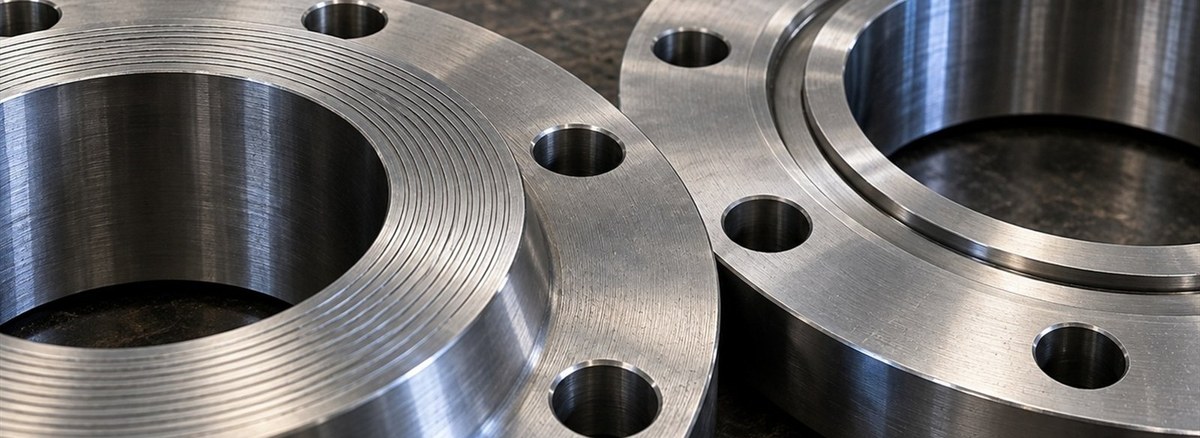
The flange face is where the gasket sits and where sealing actually happens. Two flanges of the same class and size are not a safe joint if their face types differ.
Raised face (RF)
The most common type. The gasket area is raised a few millimetres above the bolting plane, so the bolt load is concentrated on a smaller area and higher surface stress is achieved for the same torque. The raise is about 1.6 mm in classes 150# and 300#, and 6.4 mm from 400# upwards. It is normally used with spiral wound gaskets.
Flat face (FF)
The face is completely flat and the gasket extends to the outside diameter. It is preferred on cast iron pumps, valves and equipment. The reason is mechanical: cast iron is brittle, and the bending moment created by a raised face can crack it. A raised face flange is therefore not bolted to cast iron equipment.
Ring type joint (RTJ)
A machined groove carries a metal ring gasket, and sealing comes from plastic deformation of that ring. It is used at high pressure and temperature, typically class 600# and above. Ring types are R (oval or octagonal), RX and BX; the ring is softer than the flange so the groove is not damaged.
| Face | Common class | Gasket | Typical use |
|---|---|---|---|
| RF | 150#–2500# | Spiral wound, kammprofile | Process and steam lines |
| FF | 150#, PN classes | Full face soft gasket | Cast iron equipment, water lines |
| RTJ | 600# and above | Metal ring (R, RX, BX) | High pressure, drilling and gas lines |
Common installation mistakes
- Bolting an RF flange to FF equipment. It risks cracking a cast iron body.
- Scratching the RTJ groove. The groove is the sealing surface; a scratch means a leak.
- Wrong gasket inside diameter. An oversized bore stops the gasket seating properly.
- Ignoring surface finish. Spiral wound gaskets typically need 3.2–6.3 µm roughness; too smooth and the gasket slips, too rough and it leaks.
See how to select a flange gasket for gasket choice.
FAQ
Can RF and FF flanges be bolted together?
It is not recommended. On cast iron equipment the bending moment from a raised face can cause cracking; both sides should share the same face type.
When is RTJ mandatory?
Usually specified from class 600# upwards, and in high temperature and gas service.
Why does surface finish matter?
The gasket seals by keying into the micro grooves of the face. Too smooth a surface gives nothing to grip; too rough a surface leaves leak paths.
Send us your material list; we reply with price and lead time the same day.
Request a quote