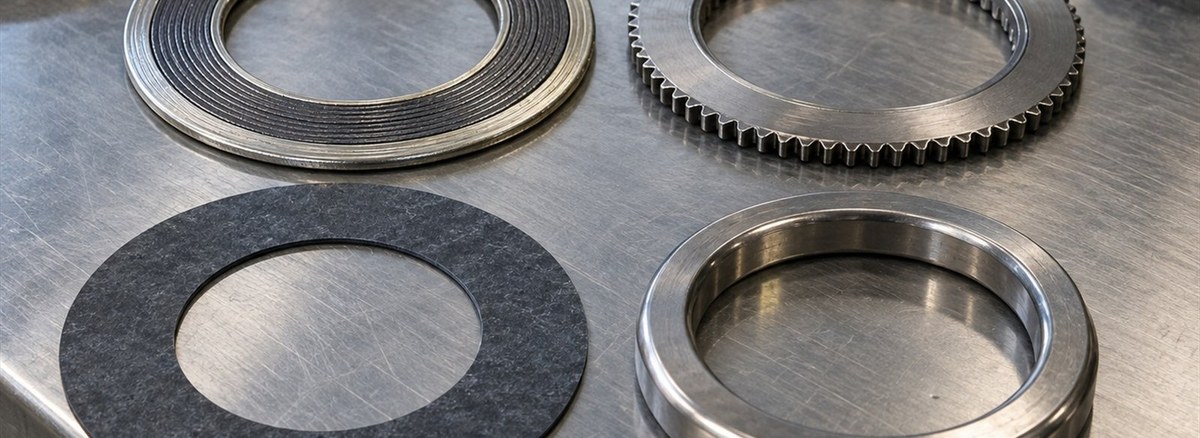
The gasket is the cheapest part of a flanged joint, yet most leaks start there. The choice comes down to four pieces of information: pressure, temperature, fluid and flange face.
Gasket types
- Soft gaskets (CNAF, PTFE, graphite sheet): Used on low pressure water, air and general service. Inexpensive and can be cut to size, but they relax over time at high temperature and under cyclic pressure.
- Spiral wound gaskets: Made by winding metal strip with a filler. The standard answer for process lines. Filler is graphite or PTFE; winding material is usually 304, 316L or a grade matching the line.
- Kammprofile gaskets: A grooved metal core faced with a thin graphite layer. Preferred where joints are opened often and high bolt load is available, especially on heat exchangers.
- Metal ring (RTJ): For high pressure joints with machined grooves; sealing comes from permanent deformation of the ring.
- Isolation gasket sets: Used on cathodically protected lines for electrical separation; the set includes the gasket body, sleeves and washers.
Four inputs that decide the choice
| Input | Effect |
|---|---|
| Pressure class | A soft gasket may do at 150#, while 300# and above usually call for spiral wound |
| Temperature | Above about 200 °C graphite filler is preferred over PTFE |
| Fluid | Graphite is unsuitable in oxidising service; chloride service calls for 316L or better winding |
| Flange face | Spiral wound and kammprofile on RF, full face soft gasket on FF, metal ring on RTJ |
Inner and outer rings
Spiral wound gaskets can be ordered with inner and outer rings. The outer ring centres the gasket and limits over compression. The inner ring stops the winding from buckling inwards at high pressure and reduces turbulence. It is recommended in vacuum, high pressure and graphite filled applications.
Installation rules
- Clean off all old gasket residue without scratching the face
- Install the gasket dry; adhesives and grease do not improve sealing
- Tighten in a star pattern with staged torque
- Re check torque after the first heat up on thermally cycled lines
- Never reuse a gasket; fit a new one every time the joint is opened
See our gasket page for the range, or send sizes and quantities through the enquiry form.
FAQ
What temperature can a spiral wound gasket take?
It depends on the filler. Graphite filled types are stable at high temperature, while PTFE filled types offer chemical resistance with a lower temperature limit.
Can a gasket be reused?
No. It deforms permanently during tightening and must be replaced whenever the joint is opened.
Why must gaskets be installed dry?
Grease and adhesives reduce the grip on the face and increase the risk of the gasket sliding as temperature rises.
Send us your material list; we reply with price and lead time the same day.
Request a quote