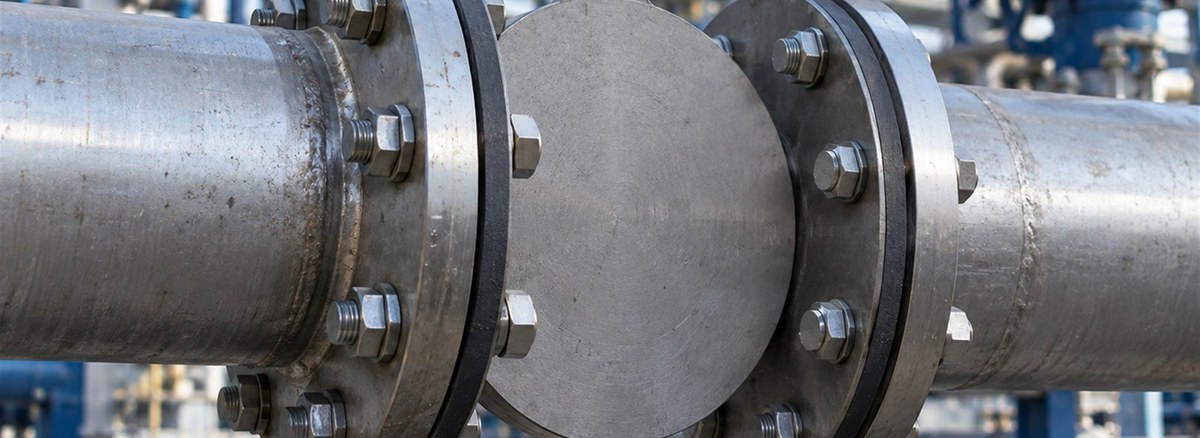
Every refinery and process plant has a drawer full of steel parts that look like giant spectacles. They are the blinding elements that prove a line is truly isolated during maintenance.
Three types
| Type | Construction | Where it is used |
|---|---|---|
| Spectacle blind | One solid end, one open end, joined in the middle | Lines blinded often; both positions stay with the line |
| Figure 8 blank | Same idea, two separate pieces | Large sizes where weight becomes an issue |
| Spacer and blind | An independent solid plate plus a spacer of equal thickness | Lines that are rarely blinded |
With a spectacle blind you simply rotate the part: the solid side closes the line, the open side lets flow continue. Because the position is visible from a distance, it is preferred for maintenance safety.
Why not just a blind flange
A blind flange closes the end of a line. Blinding elements sit mid line between two flanges. Closing a valve is not isolation, because a valve can leak. When confined space entry, welding or equipment removal is involved, a physical break is required.
Thickness calculation
Blind plate thickness is calculated from line pressure, diameter and material, and it is not the same as flange thickness. A plate that is too thin deforms permanently under pressure. Always state design pressure and temperature on the enquiry.
As plate thickness increases, so does the gap between the flanges, so stud length must be recalculated for the blind.
Installation notes
- Fit a new gasket every time the blind is changed
- Depressurise and drain the line before installation
- Record the blind position in the maintenance list and remove it when work is complete
- State lifting lugs and handle length with the order for heavy plates
Let us plan blinds, gaskets and stud sets together: enquiry form. For closing line ends, see what is a blind flange.
FAQ
What is the difference between a spectacle blind and a figure 8 blank?
A spectacle blind is one piece rotated to change position; a figure 8 blank does the same job in two separate pieces, which helps handling in large sizes.
How is blind plate thickness determined?
From design pressure, diameter and material. It need not equal the flange thickness.
Does stud length change when a blind is fitted?
Yes. Extra length equal to the plate thickness is needed, so ordering as a set avoids confusion.
Send us your material list; we reply with price and lead time the same day.
Request a quote