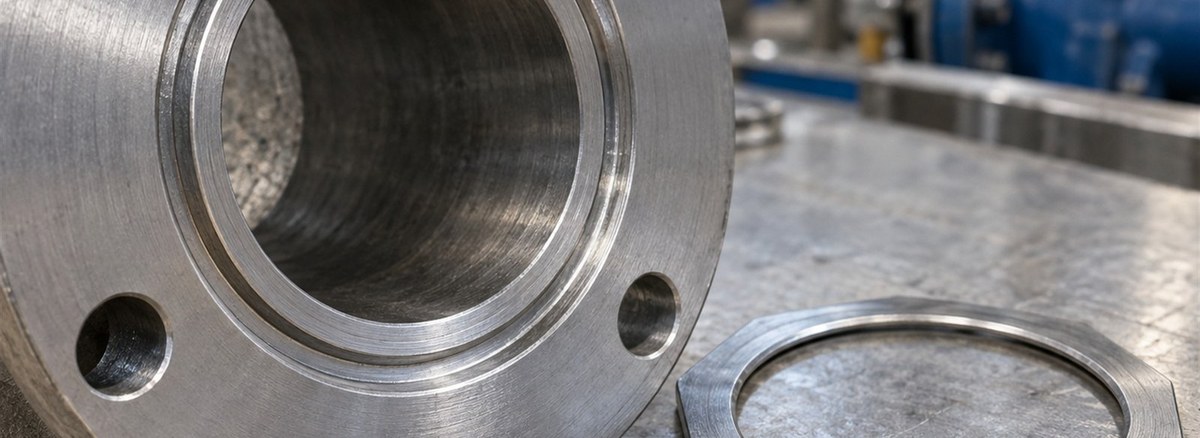
Above class 300#, particularly in upstream oil and gas and refining, the face type is often specified as RTJ. Sealing here comes not from crushing a gasket but from permanent deformation of metal.
How it works
A groove of defined geometry is machined into the flange face. A metal ring gasket sits in that groove, and as the bolts are tightened the ring deforms plastically into full contact with the groove. The ring is always softer than the flange so the groove is not damaged.
Ring types
| Type | Section | Where it stands out |
|---|---|---|
| R (oval) | Oval | Older plants, matching existing grooves |
| R (octagonal) | Octagonal | Common in new plants; better defined contact |
| RX | Pressure energised | API 6B flanges; line pressure reinforces the seal |
| BX | Pressure energised, closed groove | API 6BX, very high pressure |
Oval and octagonal rings are interchangeable in the same groove size, but octagonal seals better. RX and BX are used with their own flange types and are not interchangeable.
Groove care is the seal
If the groove surface is scratched, sealing is lost. Therefore:
- Clean and visually inspect the groove after every dismantling
- Use the ring once; never refit a removed ring
- Never use wire brushes or abrasive paper on the groove
- Protect the groove with covers during transport and storage
Material selection
Ring material follows the line material and service: soft iron, low carbon steel, 304, 316, duplex or Inconel. NACE MR0175 hardness limits apply to the ring in sour service, and ring hardness must always stay below that of the flange.
When ordering
State size, pressure class, flange standard, ring number (such as R 45 or R 46), ring material and any hardness requirement. See flange face types and how to select a flange gasket for the background.
We supply rings and flanges together: enquiry form.
FAQ
Do oval and octagonal rings fit the same groove?
Yes, at the same ring number both can be used. The octagonal section gives better contact and sealing.
Can an RTJ ring be reused?
No. It deforms permanently during tightening and must be replaced.
From which class is RTJ required?
It is usually specified from class 600 upwards, and may appear in lower classes in high temperature and gas service.
Send us your material list; we reply with price and lead time the same day.
Request a quote