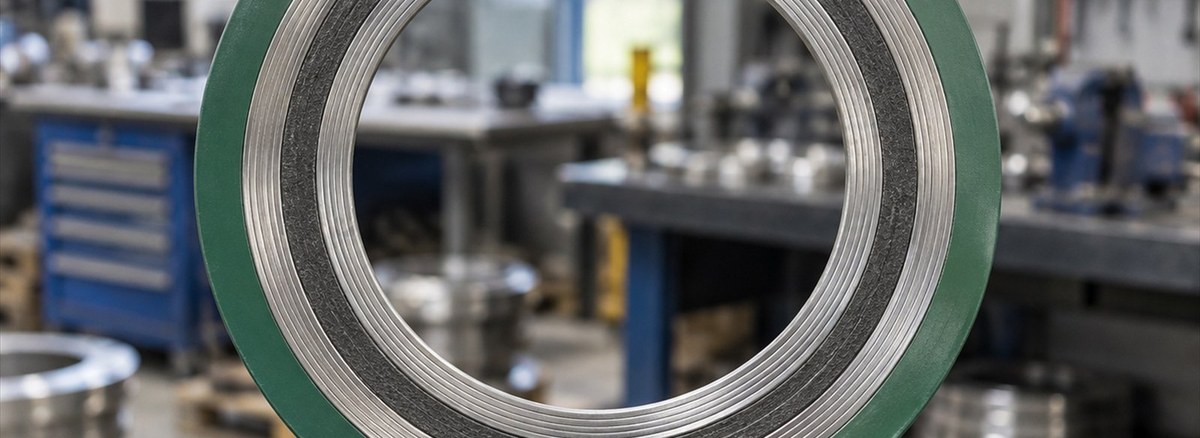
The spiral wound gasket is the most widely used metallic gasket in process plants. Selected and installed correctly it seals at high pressure and temperature for its full service life. Selected wrongly, it can fail badly enough to end up inside the line.
Three components
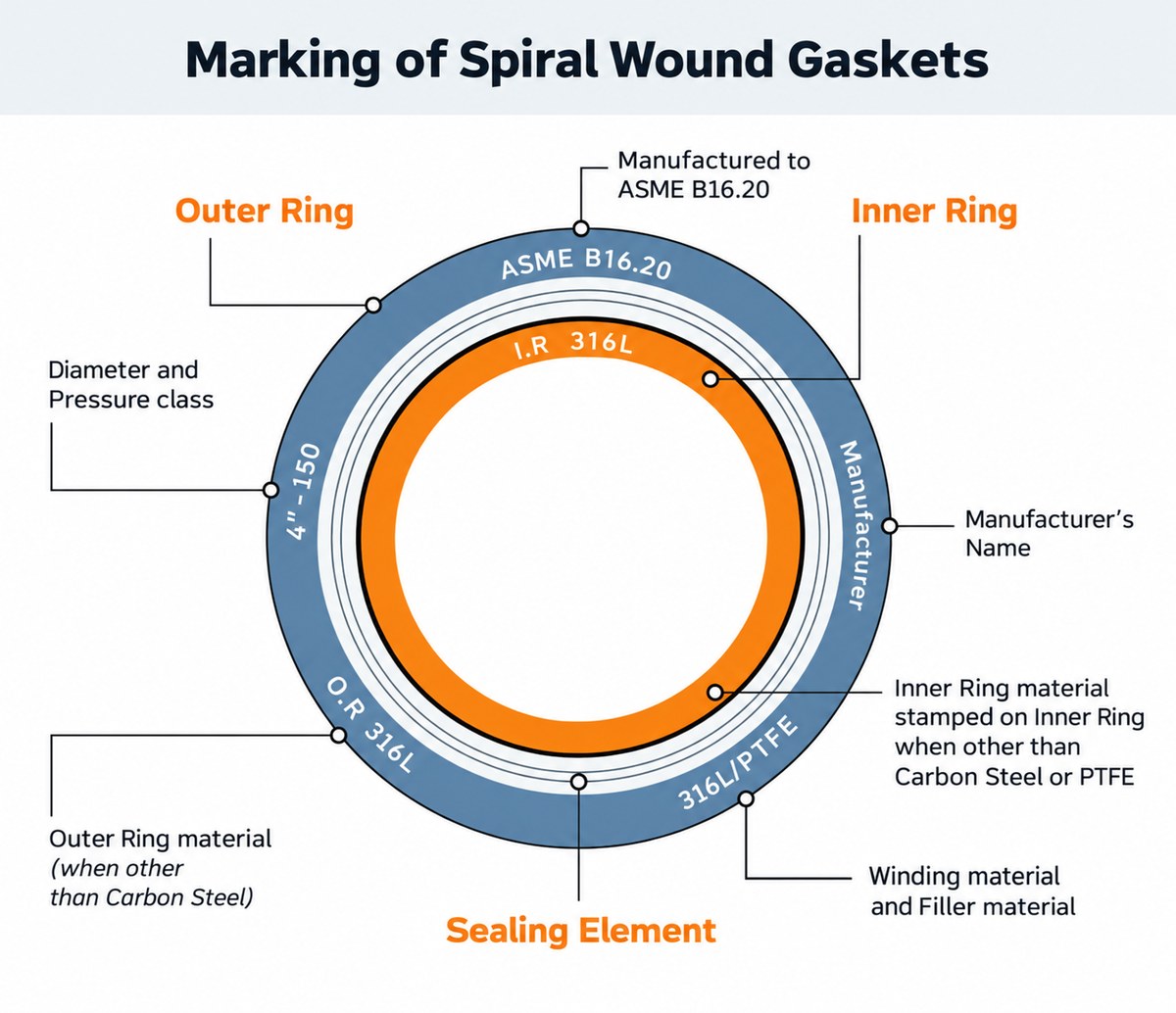
- Outer ring. Usually carbon steel. It centres the gasket in the flange, which is why it is also called the centring or guide ring.
- Inner ring. It stops the windings buckling inwards under pressure. A buckled gasket sheds pieces into the line; those pieces travel along the pipe until they wrap around rotating equipment such as a pump. The field name for the resulting mess is a "bird's nest". The inner ring exists to prevent exactly that.
- Sealing element. The windings and the filler together. In refining and petrochemicals the filler is usually flexible graphite: it withstands high temperature and tolerates flange distortion and slight misalignment. PTFE filler leads in chemical resistance but is not suited to high temperature. Winding material is most often stainless steel or monel.
When an inner ring is mandatory
ASME B16.20 widened the use of inner rings with its 2008 amendment. In summary:
- All spiral wound gaskets with PTFE filler are supplied with inner rings
- Graphite filled gaskets are supplied with inner rings unless the purchaser specifies otherwise
- Regardless of filler, inner rings are required for NPS 24 and larger in Class 900, NPS 12 and larger in Class 1500 and NPS 4 and larger in Class 2500
The reason is simple: available bolt load at these sizes is very high. Excess compression pushes the winding both inward and against the outer ring, damaging it. Beyond roughly 22 ksi of gasket stress the metal windings fail completely.
Colour codes tell you the material
The colour of the rim and the stripe on it let you read the material without checking the marking:
- Rim colour: winding material
- Stripe colour: filler material
| Rim colour | Winding material |
|---|---|
| Yellow | 304 stainless |
| Green | 316 stainless |
| Turquoise | 321 stainless |
| Blue | 347 stainless |
| Orange | Monel |
| Black | Alloy 20 |
| Silver | Carbon steel |
| Brown | Hastelloy B |
| Beige | Hastelloy C |
| Gold | Inconel |
| Red | Nickel |
| Purple | Titanium |
| Stripe colour | Filler material |
|---|---|
| Grey | Graphite |
| White | PTFE |
| Pink | Mica |
| Light green | Ceramic |
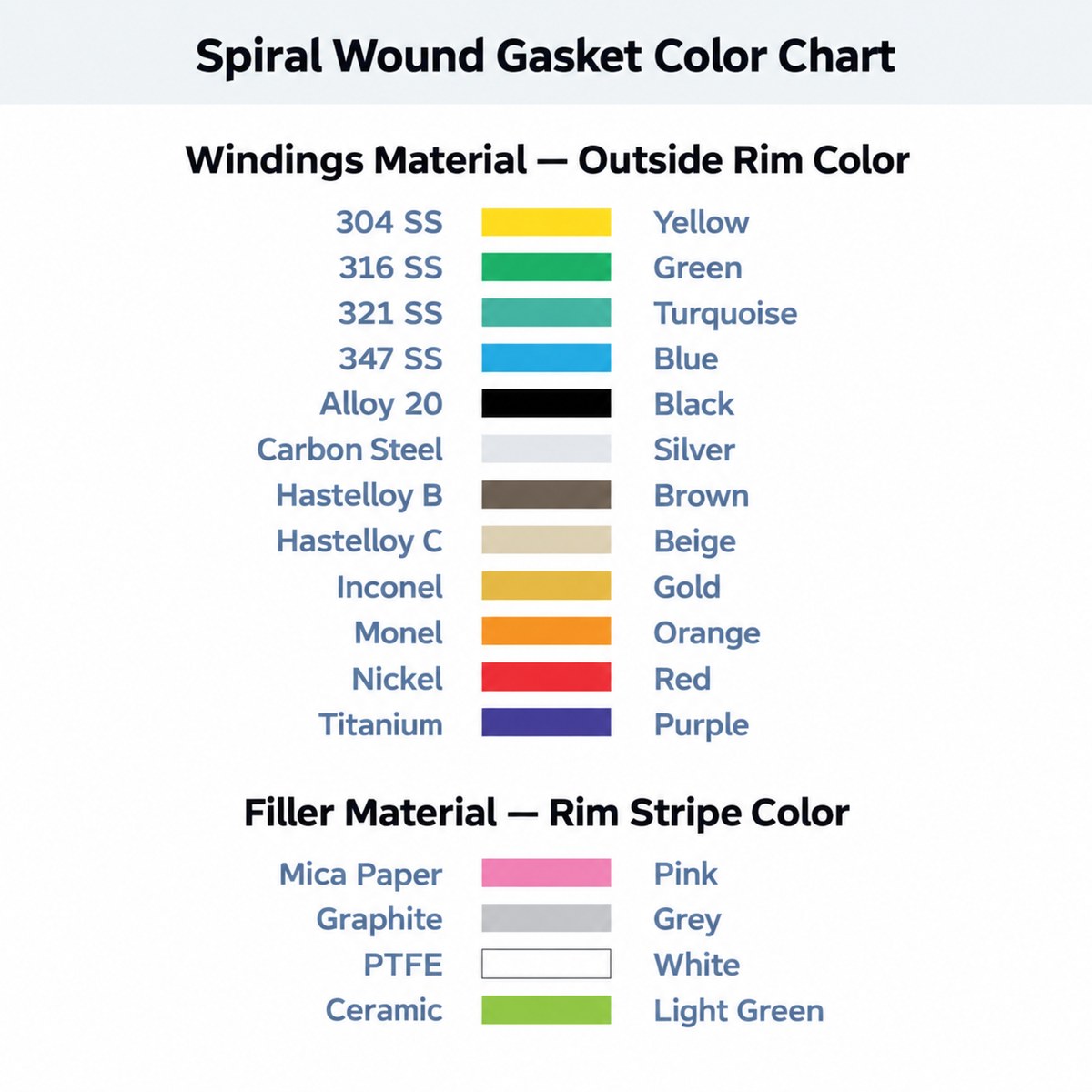
In oil and gas the common combinations are yellow (304), green (316) or orange (monel) rims with a grey (graphite) stripe.
What the markings say
A gasket carries the ASME B16.20 standard reference, the manufacturer's name, winding and filler material, nominal size and pressure class. Classes run 150, 300, 400, 600, 900, 1500 and 2500, with higher numbers carrying more pressure. Marking and colour code confirm each other; if they disagree, the gasket should not be used.
Why they became the standard
Spiral wound gaskets have existed since 1912, but only became common in industrial piping in the 1990s. After asbestos containing products were banned in 1989, the industry needed a replacement for asbestos gaskets used at lower pressures and temperatures, while ring type joints covered high pressure and temperature. The flexibility and material range of spiral wound gaskets met that need, and they soon became the standard solution in ASME B16.20. Today they are preferred over RTJ gaskets even in Class 2500 flanges.
Two installation realities
The outer ring is not a compression stop
Some manufacturers describe the outer ring as a compression stop. It is not. If the gasket has been compressed down to the outer ring, what remains is effectively a flat metal gasket with no recovery. When the plant cycles and the flange faces move apart, the gasket cannot follow and a leak starts.
Flange faces do not close flat; they rotate
On a raised face flange the raised area acts as the fulcrum of a lever, and the flange rotates a degree or two as the bolts are tightened. That rotation bends the outer ring downwards, which is known as dishing.
Dishing is not an assembly error but a mechanical consequence. The classic example: a 2" 300# and a 2" 600# joint take the same gasket, but the 300# has a raised face of about 1.6 mm and the 600# about 6.4 mm. With the lever four times longer, dishing is far more visible on the 600#. The same happens on 1500# and 2500# gaskets with their long outer rings.
That is why "you over torqued it, redo the joint" usually changes nothing; the same picture returns. What should be checked is whether the torque was applied evenly and whether the gasket was the right choice.
When ordering
State size, pressure class, standard (ASME B16.20), winding material, filler material, whether an inner ring is required and its material. Winding material follows the line material, and filler follows the service temperature.
See our gasket page and how to select a flange gasket, and send your list through the enquiry form.
FAQ
Is an inner ring always required?
Always with PTFE filler, and with graphite filler unless otherwise specified. It is also mandatory at NPS 24 and above in Class 900, NPS 12 and above in Class 1500 and NPS 4 and above in Class 2500.
What does the rim colour mean?
It identifies the winding material, while the stripe on the rim identifies the filler: grey for graphite, white for PTFE.
Does the outer ring stop compression?
No. A gasket compressed to the level of the outer ring loses its recovery and leaks under thermal cycling.
Why does the outer ring bend?
As bolts are tightened the flange rotates a degree or two and bends the outer ring downwards. This is dishing, and it is more visible as the raised face height increases.
Send us your material list; we reply with price and lead time the same day.
Request a quote